The Skincare Step That Happens Before You Even Open the Cabinet
There’s a specific kind of frustration that comes from doing everything right. You’ve found the cleanser that doesn’t strip your skin. You’ve spent real money on a moisturizer with ceramides. You’ve committed to sunscreen. And yet every winter — or sometimes every week — the dryness comes back, the scalp gets flaky, and the hair starts breaking in ways that no conditioner seems to fix. The instinct is to try a different product. The actual answer, more often than not, is to look upstream.
The average American takes a shower in water treated with chlorine — the same compound used to disinfect swimming pools. It’s there for a good reason: it kills pathogens reliably and cheaply at scale, and municipal water systems depend on it. What it also does, reliably, is oxidize the proteins in hair, strip the skin’s natural lipid barrier, and disrupt the slightly acidic pH that healthy skin depends on. No amount of ceramide cream fixes a problem that’s being reintroduced every morning at 7am through the showerhead.
“You can’t out-moisturize a chlorinated shower. Eventually, you have to deal with the water.”
Twelve Stages, One Inline Cylinder, No Plumber Required
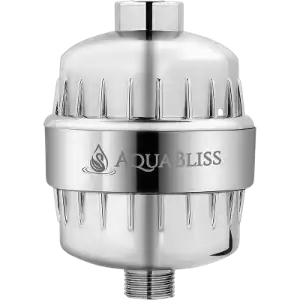
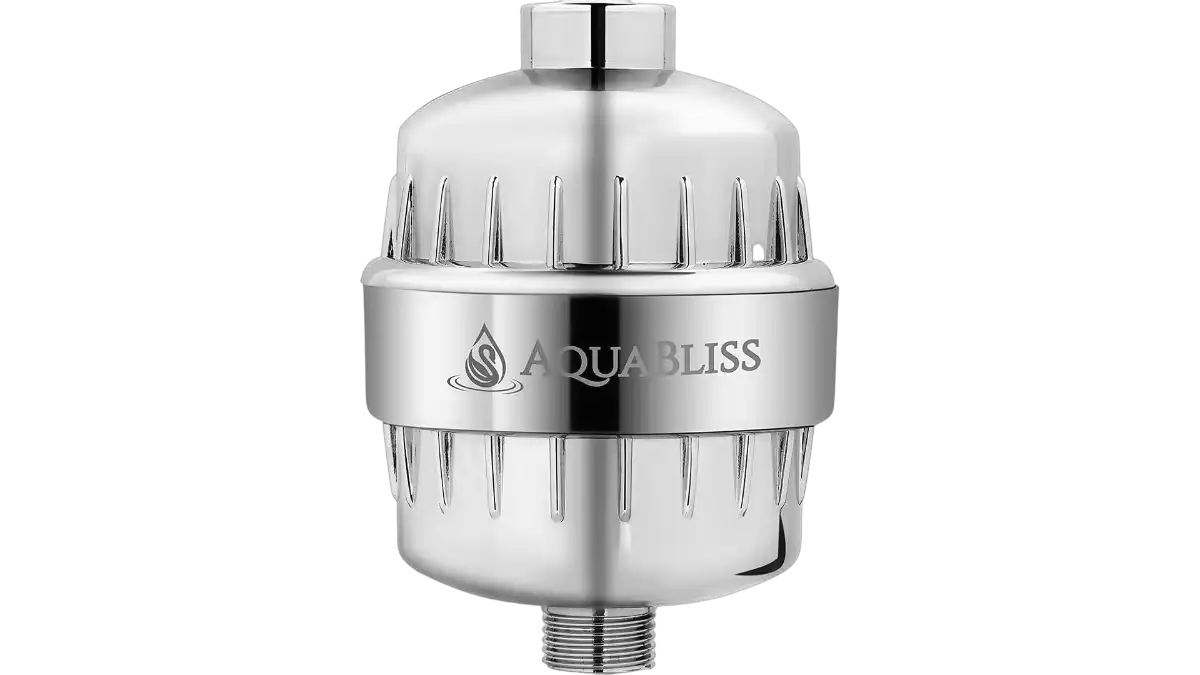
The AquaBliss SF100 is a high-output revitalizing shower filter that threads directly between your existing shower arm and whatever showerhead you already own. The chrome housing is compact, the installation is genuinely tool-free — hand-tighten only — and the whole process takes under two minutes. You keep your showerhead. You keep your water pressure. You just change what the water does to you.
What makes the SF100 different from a basic inline filter is the 12-stage media system inside. The first stages handle removal: activated carbon, KDF-55 redox media, and calcium sulfite work in combination to reduce chlorine, trihalomethanes, pesticide residue, sediment, and scale-forming particles. The later stages handle restoration: Vitamin C, tourmaline, far-infrared ceramic balls, and magnetic energy balls work to support pH balance and add back trace minerals that hard, chemical-heavy water tends to strip out. It’s a filter that takes something away and gives something back — in the same unit, at the same time.
AquaBliss has been building shower filters since 2014 and has accumulated over 50,000 verified reviews across five platforms. The brand runs a real website, offers a one-year manufacturer warranty, and maintains a U.S.-based customer support team. This is not a pop-up storefront selling wellness promises — it’s a company with a track record long enough to have repeat buyers writing three-year update reviews.
The Part Nobody Mentions in the Marketing: You’re Inhaling It Too
Most people think about shower water as a surface issue — something that contacts the skin for a few minutes and then rinses off. The exposure picture is actually more complicated than that, and understanding it changes how you evaluate the value of a shower filter entirely.
Chlorine is a volatile compound. In hot shower water, it evaporates rapidly and becomes airborne inside the enclosed space of a bathroom. Research from environmental health institutions has found that inhalation and skin absorption during a shower can account for a significant portion of total daily chlorine exposure — in some estimates, more than drinking water does. You’re not just washing in it. You’re breathing it.
“Hot water turns your shower into a small chlorine chamber. A filter addresses both problems at once.”
This is the detail the SF100’s marketing gestures at but never quite explains clearly: the benefit isn’t just softer skin after showering — it’s reduced cumulative exposure to a oxidizing agent that your body is processing every single morning. For people with eczema, rosacea, or chronic scalp irritation, removing that daily trigger often produces results that months of topical treatments couldn’t, because topical treatments were addressing the symptom while the source remained untouched.
The Vitamin C stage in the SF100 does something chemically precise: ascorbic acid neutralizes chlorine and chloramine through a direct reduction reaction, converting them into non-reactive compounds. It’s the same chemistry used in laboratory water preparation and in some municipal dechlorination processes. In the context of a shower filter, it acts as a final-stage safety net, catching any chlorine that earlier media stages didn’t fully intercept. The practical outcome for buyers is a measurable reduction in the chlorine smell during showering — something multiple verified reviewers specifically call out within the first week of use.
The Honest Verdict, Including Who Should Pass
The value-to-impact ratio on the SF100 is difficult to match in the home wellness category. For less than the cost of a single premium face serum, you are modifying the chemistry of the water your skin and hair are exposed to every day — not occasionally, not in a mask, not in a spot treatment, but in every shower, indefinitely. Replacement cartridges are designed to last six months and cost well under ten cents a day to run. For anyone already spending meaningfully on skincare and wondering why progress plateaus, the math of addressing the root cause rather than the symptoms is straightforward.
The scenario that captures the typical buyer well: you’ve had persistent dry skin or post-shower itch for a season or two, attributed it to climate or product sensitivity, and cycled through a handful of body washes without resolution. You install the SF100 on a Tuesday. Within a week, the post-shower tightness is quieter. The scalp stops flaking. The hair holds moisture longer between washes. These are the patterns that appear consistently across verified reviews — not dramatic overhauls, but the quiet disappearance of a chronic low-grade irritant.
Who should skip this: anyone whose water utility uses chloramine rather than standard chlorine as its primary disinfectant. Chloramine — a chlorine-ammonia blend increasingly adopted by U.S. municipalities, particularly in California, Texas, and parts of the Pacific Northwest — requires a different filtration approach. The SF100 does contain Vitamin C, which neutralizes chloramine through direct chemical reduction, giving it better chloramine performance than purely carbon-based filters. But if your local water report confirms high chloramine levels specifically, AquaBliss’s own recommendation is to look at their SF500 or a whole-house solution for full coverage. The SF100 is optimized for standard chlorine-treated city water — which covers the majority of U.S. households, but not all. Check your local annual water quality report before purchasing; most utilities publish it online.
On build quality: the polycarbonate housing is solid, the chrome finish resists bathroom humidity well, and the one-year warranty covers manufacturing defects in both materials and workmanship. The one mechanical note worth knowing: cartridge replacement can be slightly fiddly on the first swap due to gasket reseating — hand-tighten only, never use a wrench, and follow the included instructions. At a six-month replacement cadence, the housing itself should run cleanly for several years.
“Most skincare products treat what your shower did to you. This one changes what the shower does.”
One Last Thought
The strangest thing about a shower filter is that once you install one, you stop thinking about it — because the problem it was solving quietly disappears.