The Number That Actually Matters — and Why Almost No One Talks About It
The red light therapy category has a measurement problem. Walk through any product listing on Amazon and you will encounter two numbers that dominate the marketing: LED count and wattage. 60 LEDs. 120 LEDs. 300 LEDs. 100W. 300W. 500W. These numbers are real and measurable, but they are not the number that determines whether a device actually delivers therapeutic light to the tissue underneath your skin. That number is irradiance — specifically, how many milliwatts of light energy per square centimeter reach the treatment surface at the distance you are actually standing or sitting during a session.
Irradiance is the variable that researchers use when designing photobiomodulation protocols. It is what determines dose. It follows the inverse square law — double the distance from the panel, and you receive roughly one-quarter of the energy. A device with 300 LEDs but mediocre irradiance at six inches will deliver less therapeutic light than a device with 60 LEDs and strong, measured irradiance at the same distance. And yet the 300-LED device will almost certainly rank higher in Amazon search results and look more impressive in a side-by-side comparison, because LED count is a number buyers can see and understand intuitively. Irradiance is not.
“More LEDs is the horsepower myth of red light therapy. What matters is how much energy actually reaches your skin.”
What BestQool Gets Right That Most of This Category Gets Wrong
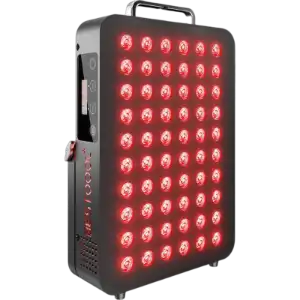
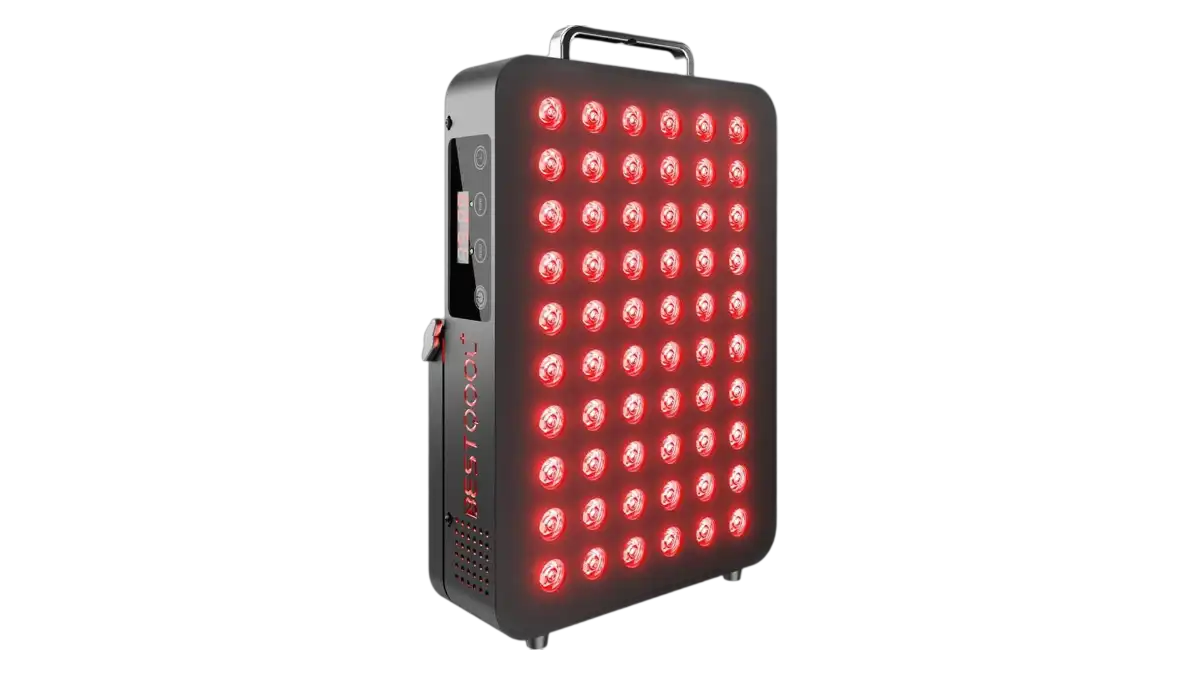
The BestQool BQ60 panel — the 60-LED, 105W model — sits at #16 in Amazon’s Light Therapy Products category and has accumulated several hundred verified reviews over years of consistent availability. The brand is a dedicated red light therapy company with its own website, a growing product line, and a stated commitment to transparent, measured irradiance data rather than estimated or extrapolated figures. The BQ60 publishes 95.6 mW/cm² at three inches as its irradiance specification.
That number has been tested by independent buyers. One verified reviewer, who described running their own wattage measurements, found actual power consumption of approximately 90W — close to the stated 95W ± 5W tolerance — and noted that the irradiance figures follow the inverse square law accurately across distances. In a product category where inflated specs are the norm and self-reported data is rarely verifiable, that result is unusual enough to be meaningfully differentiating. The reviewer specifically compared the BestQool to a more expensive competitor and found the BestQool’s irradiance data more reliable.
The panel uses dual-chip LEDs at two wavelengths: 660nm in the red range, which penetrates to approximately two to three millimeters below the skin surface and is the wavelength most associated with dermal collagen activity and surface-level tissue response; and 850nm in the near-infrared range, which penetrates deeper into muscle and joint tissue. Both are the wavelengths that appear most frequently in the photobiomodulation research literature. The mechanism under study is the response of cytochrome c oxidase — a photoreceptor enzyme in the mitochondrial electron transport chain — to photon absorption at these wavelengths, leading to increased adenosine triphosphate production in treated cells. The research on this mechanism is substantial and ongoing; it is not fringe biology.
The Part of the Spec Sheet That Most Buyers Skip Entirely
Electromagnetic field emissions — EMF — from electronic devices are a legitimate consideration for any device used in close proximity to the body on a daily basis. The BestQool BQ60 measures at 0 EMF at six inches. BestQool publishes this figure prominently and explains the measurement distance, which is the standard reference point for panel-style devices. This is worth noting not because EMF from red light panels is a widely documented concern at the intensities involved, but because the willingness to publish a verified zero reading at a specified distance reflects the same data-transparency ethos that makes the irradiance figures credible.
The built-in timer is a feature that matters more in practice than it appears to on the spec sheet. Photobiomodulation dose is a function of irradiance multiplied by time. Under-dosing produces minimal response; the research also suggests that excessive exposure duration does not proportionally increase benefit and may eventually produce a biphasic response. Having a built-in timer removes one variable from daily use — you set the duration once, the device handles it, and you are not relying on a phone alarm or estimation. The door-hanger kit included in the box is similarly practical: it allows the panel to be suspended at face or body height without requiring a dedicated stand, which matters for buyers integrating this into a small apartment or home office routine.
“A timer is not a luxury feature. It is the difference between a consistent protocol and a guessing game.”
The Verdict — Including the Specific Buyer Who Should Look Elsewhere
The value-to-impact ratio on the BestQool BQ60 is strongest for buyers who want a verified entry point into home red light therapy without paying for a full-body panel they are not ready to commit to. A dedicated 10 to 20-minute daily session targeting the face, neck, shoulders, or a specific area of chronic discomfort — the kind of targeted use the 105W panel is optimized for — costs nothing after purchase and scales naturally into a routine. Compared to the ongoing cost of professional light therapy sessions, the math closes quickly.
The scenario that fits this device well: you work from home, you have a hook on the back of your office door, and you want something you can run during a call or a reading session without reconfiguring your space. The door-hanger kit handles the setup. The timer handles the session. The irradiance is sufficient at the distances involved. You build the habit before deciding whether to expand the coverage area.
Who should skip it: buyers whose primary use case is full-body treatment. The BQ60 is sized for targeted sessions, not coverage of the full torso and legs in a single position. BestQool’s own product line includes modular panels that can be combined — the Pro100 and Pro200 — for buyers who want to scale up, and those units are the appropriate next step if comprehensive coverage from the start is the requirement. Buyers who also want 630nm or 940nm wavelengths in addition to 660nm and 850nm should look at BestQool’s four-wavelength Pro series, which adds the shallower 630nm red and the deeper 940nm near-infrared for a broader tissue-depth profile. The BQ60 is a two-wavelength device — the right two wavelengths, but two, not four.
Build quality is solid for the category: metal housing, flicker-free LEDs, and a cooling design that prevents heat buildup during standard session durations. The panel has been available since 2019 — a long track record by the standards of a category full of pop-up brands. The warranty is one year standard with an option to extend to three years by registering, which is a meaningful commitment from a brand operating in a space where most competitors offer 30-day return windows and call it coverage.
“The best red light therapy panel is the one you actually use consistently. This one removes most of the reasons not to.”
One Last Thought
Every wellness device eventually gets reduced to a question of whether you will use it daily for four weeks. The BestQool removes most of the reasons you would not — the setup is simple, the specs are honest, and the hook on your door was already there.