The Attention Economy Has an Eviction Notice
Here’s a number that should bother you: the average American unlocks their phone 96 times a day. That’s once every ten waking minutes. And most of those unlocks weren’t decisions — they were reflexes. The apps on your phone were engineered by some of the most well-funded behavioral scientists on the planet, and their job is to make sure you never once think before you tap.
We’ve spent the better part of a decade being handed software solutions to a software problem: screen time dashboards, app limits, grayscale mode, notification silence schedules. They’re all fine. And they all fail the same way. The moment willpower dips — a stressful Tuesday, a slow afternoon, 11pm after a long shift from the home office — you tap “Ignore Limit” and you’re back in. The solution is always one tap away from becoming the problem.
Remote work made this dramatically worse. When your office is your bedroom and your break room is your couch, the psychological scaffolding that once separated “work brain” from “scroll brain” collapsed. The loneliness epidemic added another layer: the phone became both the source of isolation and the default comfort for it. We pick it up when we’re bored, anxious, lonely, or procrastinating — and increasingly, for no identifiable reason at all.
“The apps were designed to be irresistible. Maybe the solution should require a little more than tapping ‘Skip’.”
The Answer Was Always Going to Be Physical
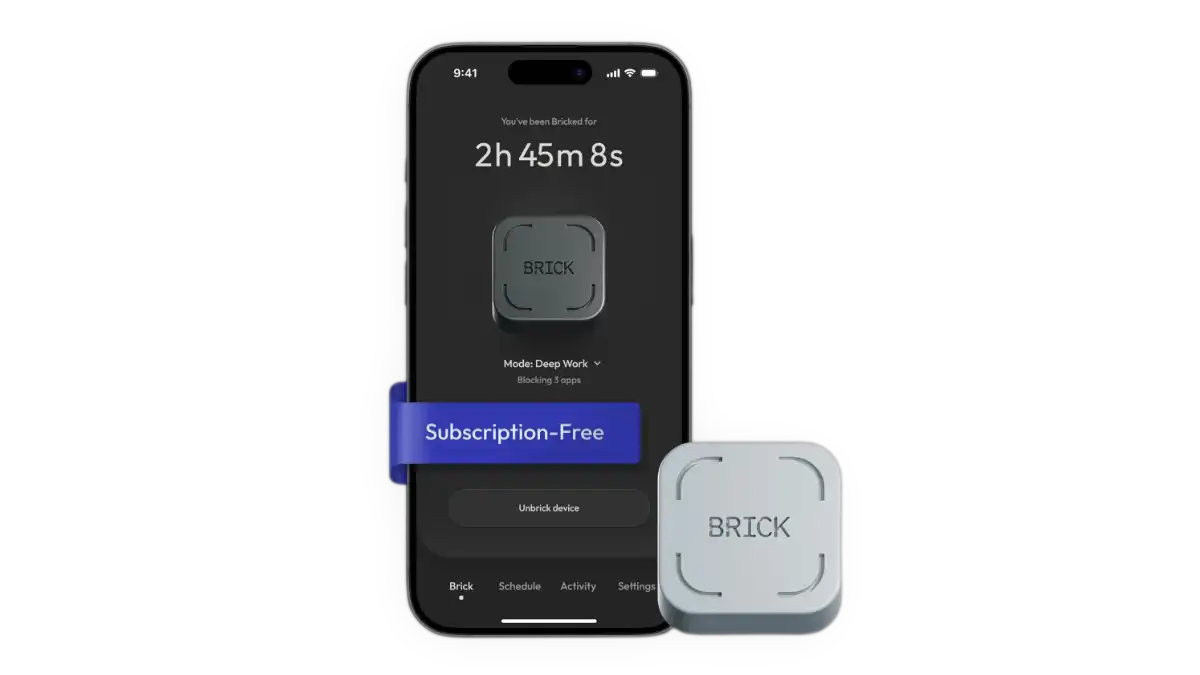
The Brick is disarmingly simple. It’s a small, palm-sized device — built from high-grade magnet and anti-slip silicone — that pairs with a free companion app on your phone. You choose which apps to block, tap your phone to the Brick to activate the lock, and place the device somewhere physically inconvenient. To get your apps back, you have to physically go find it and tap your phone again. That’s it.
No subscription fees. No monthly costs. One device, lifetime access to the app, and up to ten customizable modes for different contexts — Work, Family Time, Study, Wind Down, whatever your day requires. Each mode has its own distinct set of blocked apps, so your Work mode might mute social media but preserve Slack, while your Family Time mode might wall off everything except maps and the phone itself.
One Brick can work across multiple phones. One phone can work with multiple Bricks if you want one at your desk, one at the kitchen table, and one in the car. The cross-platform support covers both iOS 16.2 and later and Android 12 and later. And for those moments when something genuinely urgent arises, there are five Emergency Unbricks built into the app — a failsafe, not a loophole.
“It doesn’t take away your phone. It just puts the key in another room.”
You Didn’t Need Another App. You Needed Friction.
Here’s the insight most people miss: the Brick isn’t really a technology product. It’s a behavioral architecture tool. The entire premise is built on a concept from behavioral economics called “friction design” — the idea that small physical obstacles are remarkably effective at interrupting automated behavior. The Brick doesn’t make doomscrolling impossible. It just makes it require a walk.
That distinction matters enormously. Every software-based solution fails because the key to unlock it is always present. Your phone is right there. The override button is right there. The delete option for the blocking app is right there. The Brick severs that proximity. When the device is in your kitchen and you’re in your home office, the decision to unblock your apps is no longer reflexive — it’s intentional. You have to want it enough to get up.
The Strict Mode feature deserves particular attention here. It prevents you from deleting the Brick app or adjusting phone settings to circumvent the block. This is where most screen time tools fall apart — you can outwit them in under thirty seconds when your brain is in low-willpower mode. Strict Mode closes that exit. It’s the first tool of this category that seems to understand that the person who set up the block and the person who wants to override it are, neurologically speaking, different people operating under different conditions.
There’s also the usage tracking feature, which quietly surfaces something uncomfortable: how long you actually stay focused when you commit. The timer starts the moment you brick your phone. Watching that number grow — or not — creates a feedback loop that most productivity systems completely neglect. It’s not about shame. It’s about visibility.
The Brick is also now HSA and FSA eligible — a designation that signals something meaningful. The healthcare system is beginning to formally recognize phone addiction and attention dysregulation as legitimate health concerns. That’s not marketing language. That’s classification.
“The person who set up the block and the person who wants to override it are not operating with the same brain. Strict Mode kno“It doesn’t take away your phone. It just puts the key in another room.”ws this.”
What You Actually Get Back
The value-to-impact ratio of the Brick is unusual because the impact compounds. The first week, you might notice you’re reaching for your phone and getting the block screen instead. The second week, you start noticing how automated those reaches were. By the third, you’re making actual decisions about when to be connected, rather than simply reacting to whatever your nervous system defaults to when it’s understimulated.
For remote workers specifically, this is the tool that reinstates structure where architecture used to provide it. The office building’s physical separation between ‘work’ and ‘not-work’ was doing a lot of invisible cognitive labor that we’re now responsible for manufacturing ourselves. The Brick externalizes that boundary in a way that a calendar block or a focus timer simply cannot.
The one limitation worth naming honestly: this is a tool that works best when you want it to. If you’re not meaningfully motivated to change your relationship with your phone, you’ll use the emergency unbricks and eventually move the device somewhere convenient. No gadget fixes ambivalence. But if you’ve already exhausted every software solution and keep finding yourself in the same scroll session you vaguely remember starting, the Brick addresses something those tools were structurally incapable of addressing.
“Every hour the Brick is active is an hour you chose to spend on something you actually intended.”
The Thought You Won’t Be Able to Let Go
There’s something quietly confronting about a product whose entire value proposition is that you can’t trust yourself with a button. Not because you’re weak — but because the button was designed by people whose entire job was to make sure you couldn’t. The Brick doesn’t judge that. It just moves the button to another room.
The most expensive thing you own might not be your phone — it might be the attention your phone has already spent for you.