How a device the size of a credit card is quietly solving one of remote work’s most persistent and unspoken burdens.
The Tax Nobody Adds to the Calendar
There is a type of work that doesn’t appear on any timesheet, doesn’t count toward any productivity metric, and doesn’t stop accumulating no matter how efficiently you run your day: the cognitive overhead of meetings. Not the meetings themselves — the reconstruction afterward. The ten minutes of staring at a blank document trying to remember what was actually decided. The follow-up email that’s 80% accurate because you were listening instead of writing and couldn’t do both at the same time. The action item you were certain someone else owned but can’t prove because nobody captured it. For the estimated 55 million meetings that happen every workday in America, this reconstruction tax is paid in full, every time, by everyone in the room.
Remote work normalized the calendar as a workday architecture — back-to-back video calls replaced office drop-ins, and with them came a documentation gap that no app has fully closed. Otter, Fireflies, and built-in transcription tools help for online meetings. They do nothing for in-person conversations, hallway decisions, phone calls, or the client lunch where someone said something important and nobody had a recorder running.
The problem was never the meeting. The problem was everything that happened between the meeting and the moment someone needed to know what was said.
A Recorder That Disappears Into the Background
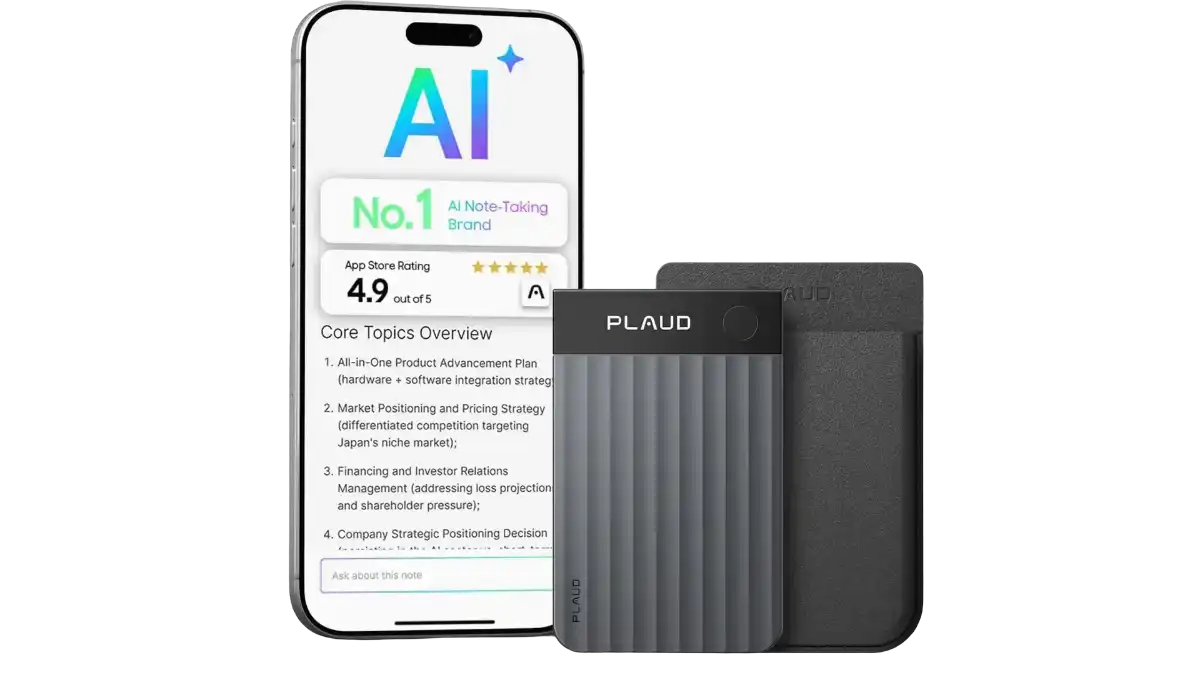
The Plaud Note Pro is 2.99mm thin — about the depth of three credit cards stacked together — and weighs 30 grams. It snaps magnetically to the back of a MagSafe iPhone, or to any phone via an included adhesive ring, and becomes functionally invisible within about thirty seconds of arriving at a meeting. You press one button to start recording. That’s the entire manual interaction required.
What happens after that is where the product earns its position. Four precision MEMS microphones and a Voice Processing Unit handle AI beamforming — focusing pickup toward active speakers rather than absorbing the whole room equally — with a clean capture range of up to five meters. A Vibration Conduction Sensor on the device body detects when it’s pressed against a phone mid-call and automatically switches to phone call mode, capturing the internal audio of the conversation rather than the ambient sound of the room. No toggling, no mode selection, no remembering to change settings before a call that starts in thirty seconds.
The AMOLED InstantView display — a 0.95-inch screen protected by Corning Gorilla Glass at 600 nits — shows battery level and recording status at a glance. It’s a small addition that solves a specific and real anxiety: anyone who has ever used a screenless recorder knows the quiet dread of not being certain the device is actually capturing anything. The Note Pro makes that uncertainty structurally impossible.
At 2.99mm and 30 grams, it’s not a device you manage. It’s a device you forget is running — which is precisely the point.
The Part That Changes How You Work
The hardware is impressive for its size. But the hardware is not the product. The product is what happens when the audio reaches the Plaud app.
Transcription runs across 112 languages with speaker labels — the AI identifies and differentiates individual voices automatically, tagging each contribution to its speaker in the transcript without any manual annotation. Custom vocabulary lets you add names, technical terms, and product names that would otherwise get mangled by generic speech recognition. Accuracy across real-world multilingual and multi-speaker environments is consistently strong enough that the transcript is usable without heavy correction.
The summary layer is where the real time savings compound. Over 10,000 professional templates — meeting minutes, sales call summaries, interview notes, medical SOAP notes, sprint retrospectives, client debriefs — are applied contextually based on the nature of the conversation. You can also build custom templates for recurring meeting types, so the output consistently matches the format your team actually uses. The result is not a wall of AI text that still requires editing. It’s a structured document in the format you’d have written yourself, generated from the full audio context rather than from pattern-matching against generic prompts.
“Ask Plaud” takes it one step further: a conversational interface that lets you query your recordings directly. Find the moment someone mentioned the Q3 budget. Draft a follow-up email from the last thirty minutes of the sales call. Pull the three action items assigned to the engineering team. It answers from the actual audio, not from approximation — which means the outputs are specific, attributable, and accurate in a way that generic AI assistants working without that context cannot be.
The press-to-highlight button during recording is underrated. One tap marks a moment as priority in the forthcoming summary, creating real-time human-to-AI signaling that guides the AI toward what actually mattered rather than forcing it to guess from volume and frequency alone. It’s a small interaction that takes less than a second and meaningfully improves summary quality for anyone who uses it consistently.
The summary isn’t a transcript repackaged. It’s the meeting, reconstructed in the format you’d have produced yourself — if you’d had time to produce it.
Who Gets the Most Out of This
The Plaud Note Pro makes the most unambiguous sense for professionals who spend significant portions of their week in conversations that require documentation: consultants, account managers, researchers, journalists, executives attending back-to-back briefings, medical professionals handling patient interactions, anyone whose output depends on accurately capturing what was said by whom and when.
For this group, the math is straightforward. The device battery lasts 30 hours in standard recording mode and 50 hours in endurance mode — meaning weekly charging at most for normal professional use. Recordings sync to the app automatically via Bluetooth. The 64GB local storage means the device captures continuously even without a live connection, uploading when conditions allow. The security posture — ISO 27001, ISO 27701, SOC 2, HIPAA, GDPR, and EN18031 compliance, AES-256 encryption at rest, TLS 1.2+ in transit — is enterprise-grade, which matters for anyone handling sensitive client or patient conversations.
The limitation to factor in honestly: the free Starter Plan covers 300 transcription minutes per month. A professional averaging two hours of recorded meetings daily will exceed that inside a week. The Pro Plan at around $99 per year is reasonable for the value delivered, but it’s a recurring cost that belongs in the total ownership calculation — this is not a one-time purchase in the way a traditional voice recorder is. Occasional users, or anyone already satisfied with phone-based transcription for online-only meetings, will find the case harder to make.
One additional friction point worth noting: the charging cable is proprietary — a magnetic pogo-pin connector rather than USB-C. Plaud’s reasoning is sound (a USB-C port would add bulk that defeats the 2.99mm profile), but losing the cable means waiting for a replacement. Carry a spare if this device becomes load-bearing in your workflow.
The subscription is real and the proprietary cable is genuinely annoying. Neither changes what this device is for the right professional in the right workflow.
What Changes When You Stop Taking Notes
There’s a version of a meeting where your job is to listen, respond, and think — where you’re actually present in the conversation because you’ve offloaded the documentation task to a device that handles it faster and more completely than you could. The Plaud Note Pro creates access to that version of a meeting for the first time at a consumer price point, in a form factor that doesn’t announce itself on a conference table or require any setup beyond pressing a button.
For professionals whose working days are built around conversations that matter, this is not a productivity gadget in the novelty sense. It’s a structural change to how information moves from spoken exchange to documented record — and that change, once experienced, is difficult to work around.
The best meetings end with everyone on the same page — and the Plaud Note Pro is the first device small enough to attend every single one of them.