The Alarm You’ve Been Dreading
Half of Americans reach for their phone within five minutes of waking up. Not because they want to — but because the phone is the alarm, and the alarm is the first thing that happens to them each day. A jarring buzz. A blaring tone. A sudden cortisol spike before you’ve even formed a complete thought. For the better part of human history, waking up was gradual. Light crept in. The world warmed slowly around you. Your nervous system had time to negotiate the transition from sleep to consciousness. Then we invented blackout curtains, night shifts, and the push notification, and burned the whole system down.
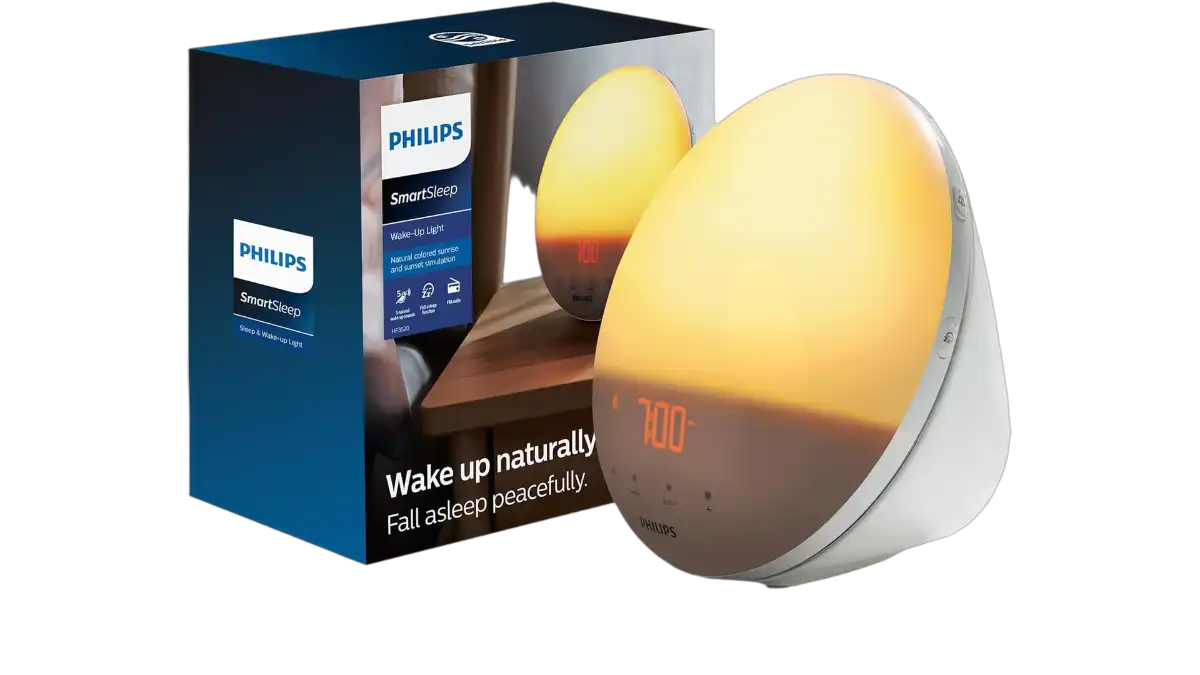
The Philips SmartSleep Wake-Up Light HF3520 is an attempt to get some of that back.
“Most people buy it for the alarm. Most people stay for the sunset.”
Light Is the Signal Your Brain Is Already Listening For
The premise here isn’t complicated, which is part of why it works. Your circadian rhythm is driven primarily by light — specifically, the spectral shift from the warm reds of dawn to the cool whites of midday. That transition signals your brain to ease off melatonin production, raise body temperature, and prep the body for activity. The HF3520 replicates that sequence in miniature, inside your bedroom, starting twenty to forty minutes before your alarm is set to go off.
It begins with a barely perceptible deep red, then moves through amber and warm orange into bright yellow-white — twenty distinct brightness steps across the full color arc. By the time your chosen wake-up sound kicks in (five options: birdsong, forest birds, zen garden, gentle piano, or seaside waves), you’re already surfacing on your own. The sound isn’t a shock. It’s more of a confirmation that you were right — it is time to get up.
“The sound isn’t a shock. It’s more of a confirmation.”
The Feature Almost Nobody Reads About on the Box
Here is what most buyers discover by accident, about two weeks in: the sunset mode might be the whole point.
The HF3520 runs the simulation in reverse. Set it before bed and the light will gradually dim from warm white down through orange and into a low, sleepy red over five to sixty minutes, then switch off entirely. This isn’t a gimmick. It’s addressing a problem that precedes the alarm problem by several hours: the reason you’re hard to wake up is often that you didn’t sleep deeply enough, and the reason you didn’t sleep deeply enough is that you were on a screen emitting blue light at 11pm, suppressing the melatonin your body was trying to produce.
The sunset mode creates a different behavioral loop. You set it, you put the phone down, and your environment starts doing the sleep-onset work that your pre-bedtime scrolling was undoing. Users who discover this feature tend to describe the same arc: they bought it to fix their mornings, and it ended up fixing their nights.
The light itself is LED, rated for approximately twenty years of use, which also means it runs cool to the touch and draws minimal power. It doubles as a bedside reading lamp with ten independent brightness settings — warm, non-stimulating light that won’t derail your wind-down the way overhead lighting does. The device functions across both roles without you having to think about it.
“They bought it to fix their mornings. It ended up fixing their nights.”
Who This Is Really For (And Who Should Look Elsewhere)
The value-to-impact ratio here is front-loaded: the first morning you wake up to gradual light instead of a sound blast, something clicks. It’s not that the alarm was loud — it’s that you realize how conditioned you’d become to dreading it. That shift, subtle as it sounds, has a measurable downstream effect on how you approach the day. Multiple users with sleep trackers have noted meaningful improvements in perceived sleep quality and morning alertness, not from sleeping more, but from transitioning out of sleep differently.
Picture this: it’s January, the sky is black at 6:45am, and your body has no external cue that morning exists. The HF3520 manufactures that cue. By the time the alarm sounds, you’re already halfway there — eyes open, room warm with simulated daylight, zero disorientation. That’s the scenario it was built for, and it delivers.
Who should skip it: if you want app control, Spotify integration, sleep tracking synced to your wearables, or the ability to schedule different alarms for different days of the week without manual intervention, look at the Hatch Restore 3 instead. The HF3520 has no app, no Bluetooth, no battery backup (a power outage resets your settings — genuinely annoying), and five sounds is five sounds. This is a purpose-built single-task device. It doesn’t try to be your smart home hub, and that’s either its greatest limitation or its most underrated feature, depending on what you’re asking it to do.
On longevity: the LED panel is rated for approximately two decades of use, Philips backs it with a 90-day no-hassle return guarantee, and the build quality is solid — there are no replaceable bulbs to fail, no cheap plastic hinges, no components with a two-year shelf life. For inflation-conscious buyers tired of replacing gadgets that don’t last, this is the kind of device that gets handed to a family member in 2036 still working exactly as described.
“A purpose-built single-task device. It doesn’t try to be your smart home hub.”
The Closing Thought
The most radical thing the Philips HF3520 does isn’t simulate a sunrise — it’s remind you, gently and daily, that your body already knew how to wake up; you just stopped giving it the right information.