
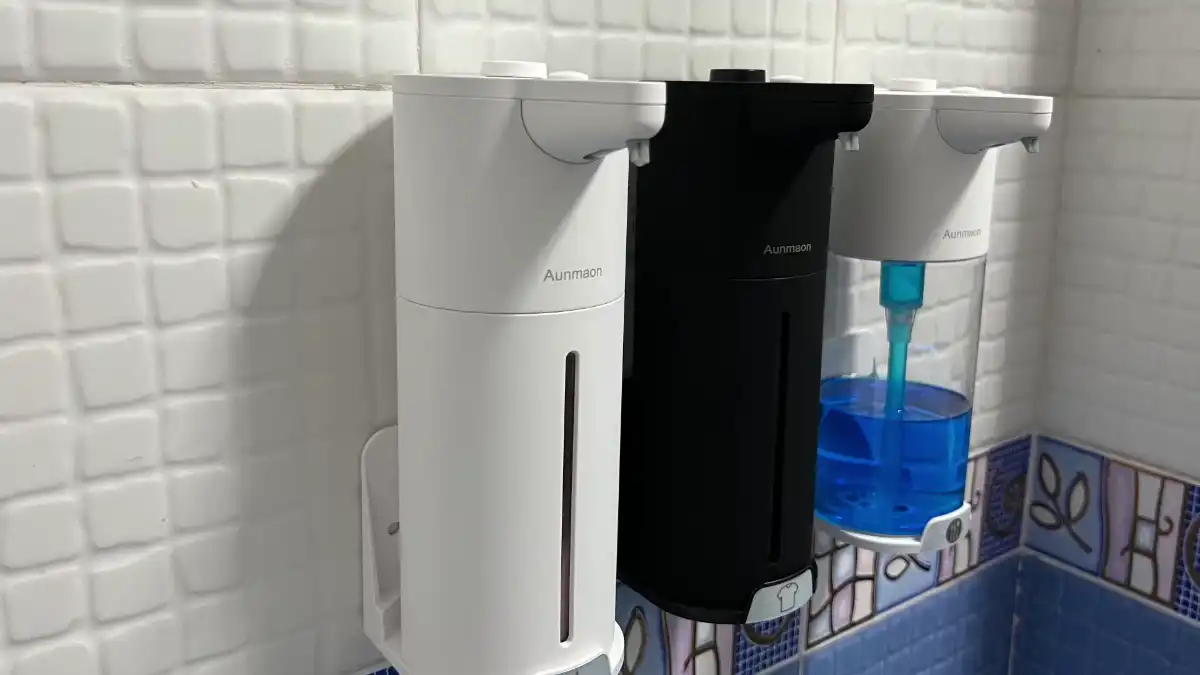
Why the Aunmaon Automatic Touchless Soap Dispenser is the smallest upgrade with the largest daily return
THE HOOK
America Is Burned Out on Small Frictions
Somewhere between the third Zoom meeting and scrubbing last night’s cast iron with raw-chicken hands, something quietly snapped. It wasn’t a dramatic breakdown. It was the tenth time this week you had to use your wrist to nudge the soap pump because your hands were too dirty to touch it — and you left a grease smear on the bottle anyway.
This is the texture of American domestic life in 2025. Remote work compressed our kitchens into offices, studios, and everything in between. We cook more, we eat at our desks, and we wash our hands more than any generation in recent memory — the CDC estimates Americans wash their hands an average of eight times a day now, nearly double pre-pandemic habits. And yet, the soap dispenser sitting on most American countertops is a design relic from 1987: a manual pump that requires you to touch it with whatever you were just trying to clean off.
That is not a minor inconvenience. It is a friction that compounds, quietly, every single day.
THE LOGIC
The Logical Fix Hiding in Plain Sight
Meet the Aunmaon Automatic Touchless Soap Dispenser. It sounds almost too simple to be worth talking about. But that is precisely the point.
This is a battery-powered, infrared-sensor-activated soap dispenser. You hover your hand beneath it. Soap appears. You never touch the bottle. The concept is not new — you have seen these in hotel lobbies and hospital corridors for years. What is new is that this category has finally crossed the quality and price threshold where it makes sense for your kitchen counter and not just the Marriott bathroom.
“You hover your hand beneath it. Soap appears. You never touch the bottle.”
The Aunmaon dispenses between 0.4ml and 2.5ml per pump, adjustable across 15 precision levels via a simple dial on top. It handles both thin hand soaps and thick dish soaps without dilution — something most competitors in this category quietly fail at, forcing you to water down your concentrate and lose cleaning power. It runs on three AA batteries for up to a year of normal use, and it mounts flat to the wall or sits on the counter with the same footprint as a standard pump bottle.
There is no app. No WiFi. No subscription. No firmware update at 2 a.m. It just works, every time, without asking anything of you.
THE DEEP DIVE
The Hidden Angle: You Are Not Buying Convenience. You Are Buying Hygiene Architecture.
Here is what most people miss when they look at a product like this: the benefit is not laziness. It is contamination control — and that realization changes the value calculation entirely.
Think about your average weeknight dinner. You handle raw chicken. You reach for the soap. Your contaminated hand now touches the pump. You wash your hands. You dry them. Then someone else in your household — your partner, your kid — grabs the same pump ten minutes later without thinking about it. The bottle has become a soft vector for whatever was on your hands. This is not paranoia. This is basic germ mechanics, and the traditional pump dispenser has a structural design flaw that nobody talks about because it is so normalized.
The touchless dispenser eliminates that vector entirely. Your contaminated hands never touch a shared surface. Neither does anyone else’s. The sensor fires. Soap drops. You wash. Done.
For households with toddlers — who are developmentally incapable of not making an absolute mess with a manual pump — the low-volume setting delivers the exact right amount, every time, without negotiation. For aging parents or anyone with limited grip strength, the hands-free operation removes a friction point that was never designed with them in mind. And for the remote worker who cycles between typing, cooking, and video calls more times per day than they can count, this dispenser removes one more thing that requires physical coordination and deliberate attention.
The hidden angle is this: the people who need this most are not the germaphobes. They are the people who are simply too busy to think about it — which, in 2025, is most of us.
THE VERDICT
The Value-to-Impact Ratio Is Absurd
Let us be direct about the math. This dispenser costs roughly what you would spend on two specialty coffees. Its battery lasts a year. It eliminates a daily friction point that currently happens eight or more times every day — which means, over the course of twelve months, you will interact with this device somewhere north of 2,900 times.
That works out to fractions of a cent per frictionless, sanitary interaction. For that price, you get a cleaner counter (no pump-top soap buildup), more consistent cleaning (precise volume every time), a reduction in cross-contamination risk, and — perhaps most underrated of all — one fewer small decision eating into your mental bandwidth.
The velvet matte finish looks clean on a counter. The IPX5 waterproofing means it shrugs off splashes. The wide-mouth refill opening means you can top it up in under ten seconds. There is genuinely nothing to complain about here at this price point, which is itself a remarkable statement.
“One fewer small decision eating into your mental bandwidth — every single day.”
This is not a luxury item dressed up as practical. It is a practical item with an unjustifiably low price tag, and the only reason it has taken this long to become standard-issue in American homes is that we collectively underestimated how much the small frictions cost us.
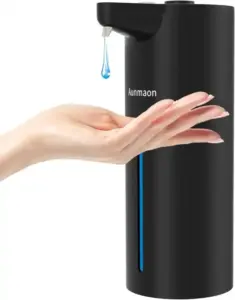
Aunmaon Automatic Touchless Soap Dispenser
CLOSING THOUGHT
We spend thousands optimizing our Wi-Fi speeds, our mattress firmness, and our coffee grind size — and then we pump soap with raw-chicken hands onto a bottle that everyone in the house touches.
Maybe the smartest upgrade in your home right now is the one that costs less than dinner.