
Your Hotel Wi-Fi Is a Security Disaster. This Fixes It.
Why the GL.iNet Beryl 7 is the most important piece of gear a remote worker can carry in 2026 — and the one most people haven’t thought to pack
THE HOOK
Remote Work Grew Up. Your Internet Security Didn’t.
Picture this: you are in a Marriott in Dallas, on a client call that could close a six-figure deal, and the hotel Wi-Fi — shared with 300 other guests, completely unencrypted — is the pipe carrying every word, every file, every credential exchange. Now picture that same scenario, except the person in Room 214 is running a packet sniffer on the same network. You would never know.
Remote work in America is no longer a temporary patch over a broken commute. It is a structural feature of the economy. Roughly 35 million Americans now work in hybrid or fully remote arrangements, and a growing percentage of them work from locations that are not their home office: hotel rooms, airport lounges, Airbnbs, co-working spaces, client sites, RVs, and cruise ships. What almost none of them have thought carefully about is this: every one of those locations runs a shared network they do not control, cannot audit, and should not trust.
The corporate VPN installed on your laptop helps. But it only protects that one device, only when it is actively running, only if you remembered to connect it before opening your email. Your phone, your tablet, your smart TV, your partner’s laptop on the same trip — all of them are exposed.
The problem is not that people are careless. The problem is that the infrastructure designed to protect them has not caught up with how they actually live and work.
THE LOGIC
A Pocket-Sized Network You Actually Control
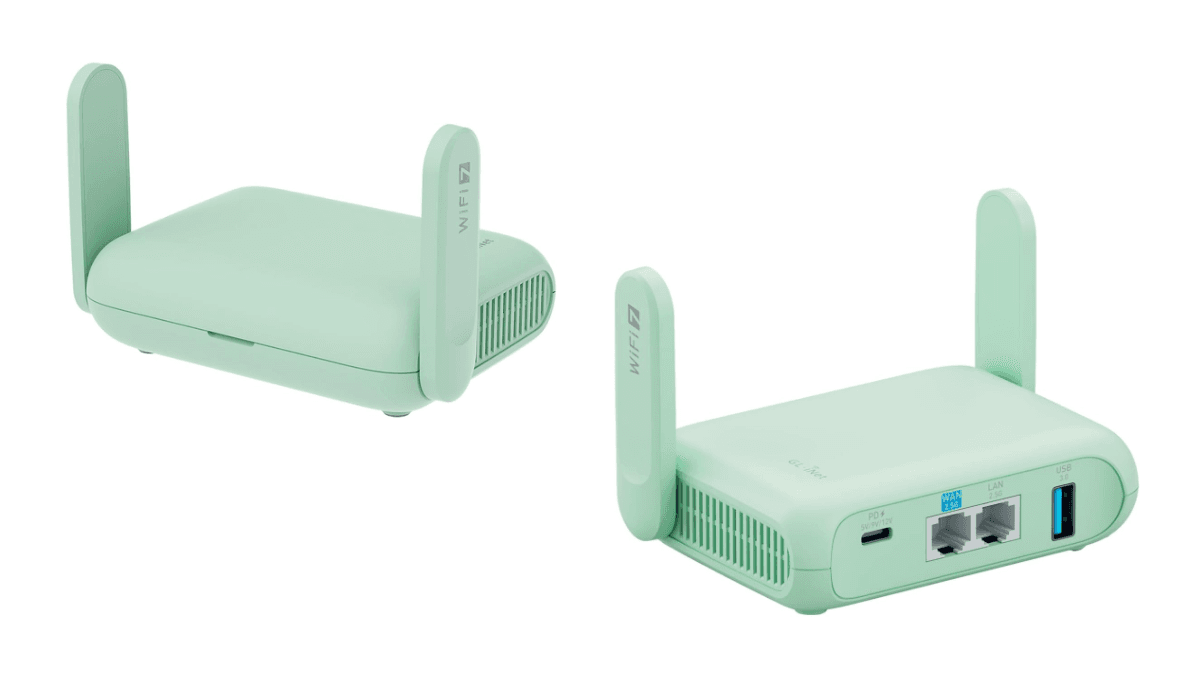
The GL.iNet Beryl 7 (GL-MT3600BE) is a portable Wi-Fi 7 travel router the size of a deck of cards. You plug it into the hotel’s Ethernet port — or relay through their Wi-Fi if there’s no wired option — and it instantly creates a private, encrypted network that belongs to you. Every device you own connects to your network. The hotel network, and everyone on it, sees only the router.
“Every device you own connects to your network. The hotel network sees only the router.”
The specs are not travel-router specs. They are home-router specs in a travel-router body. Wi-Fi 7 with dual-band speeds reaching 3,600 Mbps combined. Dual 2.5G Ethernet ports. A quad-core 2.0 GHz MediaTek processor — triple the processing power of its predecessor — that pushes WireGuard VPN speeds to 1,100 Mbps without breaking a sweat. It supports 120+ simultaneous client devices. It runs on any USB-C charger, including the one already in your bag.
Setup takes under three minutes. You connect it to the hotel internet once. Every subsequent time you power it on, your devices reconnect automatically to your own network, with VPN already running, without you touching a single setting.
THE DEEP DIVE
The Hidden Angle: This Is Not a Travel Gadget. It Is a Mobile Security Infrastructure.
Here is the perspective most people miss: the Beryl 7 is not a convenience item. It is a security architecture decision, compressed into something you can drop in a jacket pocket.
When you connect to public Wi-Fi without it, every device on your network is individually responsible for its own encryption. Your VPN covers your laptop. Nothing covers your phone unless you remember to enable a separate subscription. Your smart TV — used for that video call you did not want to have on your laptop — is completely exposed. Your partner’s device, your kid’s iPad, the Chromecast you travel with — all of them are naked on a network you don’t own.
The Beryl 7 collapses all of that complexity into a single decision made once. You configure WireGuard on the router. Every device that joins your private network is automatically protected, without installing anything, without managing separate subscriptions, without remembering to turn anything on. The router handles it at the network level, before traffic even leaves the device.
The people who need this most are not the technically sophisticated ones who already know to worry about it. They are the ones who don’t.
There is another angle that almost nobody discusses: the Beryl 7 lets you tunnel back to your home network at LAN-like speeds. Your home NAS, your development environment, your personal media server — they become accessible from anywhere in the world as if you had never left. For the growing class of Americans who have built serious home infrastructure over five years of remote work, this is not a feature. It is a lifeline.
OpenWrt firmware gives you the option to go deeper: AdGuard Home for network-wide ad blocking, custom DNS, Tor integration for high-privacy scenarios, multi-WAN failover if the hotel Ethernet dies and you need to switch to a cellular backup automatically. You never have to touch any of it if you don’t want to. But it is there, built in, free, on open-source software that has been audited by the security community for two decades.
THE VERDICT
The Value-to-Impact Calculation Is Not Close
Let’s be precise about what you are comparing. The average data breach in 2025 costs a small business $4.9 million. Enterprise VPN subscriptions that approximate the Beryl 7’s network-level protection cost $15-$30 per device per month, for every device, managed separately. A corporate-grade travel router with comparable specifications — if you can find one — costs four to five times more and requires IT support to configure.
The Beryl 7 costs roughly what you’d spend on two nights of hotel parking. It protects every device on your network simultaneously, indefinitely, without a subscription. It runs on the charger already in your bag. It weighs less than a paperback novel.
“It protects every device you own, indefinitely, no subscription, from a charger already in your bag.”
The build quality is solid — dense, purposeful, with no cosmetic excess. The web admin panel is clean enough for non-technical users and deep enough for power users. Firmware updates ship regularly. The company has a US office and warehouses its products domestically — relevant context given the current environment around network hardware provenance.
The only honest limitation: if you are a pure Apple ecosystem user who relies heavily on AirDrop or AirPlay across devices, the router’s network isolation requires a small configuration adjustment to maintain those features. It takes five minutes once and is well-documented. It is a setup cost, not a design flaw.

GL.iNet Beryl 7 (GL-MT3600BE) Wi-Fi 7 Travel Router
CLOSING THOUGHT
We spend thousands protecting our physical possessions when we travel — TSA locks, RFID-blocking wallets, travel insurance — and then we connect every device we own to a hotel network that a motivated teenager in the adjacent room could read like a newspaper.
The Beryl 7 is what it looks like when someone finally took that problem seriously — and made the solution small enough to fit in your back pocket.